

Le Bandit Demo and Review: Four Paid Cards, Four Returns
In short — our verdict: 7.3/10 — Le Bandit is a 6x5 cluster-pays slot from Hacksaw Gaming with a 96.34% default return and a 10,000x ceiling. Our score: 7.3/10. The studio ships four return versions, and your casino decides which one you get.
You can load Le Bandit in Hacksaw's own demo and read every figure the studio prints. The default return is 96.34%, the cap is 10,000x, and the four paid cards run from €6 to €500 at a €2.00 stake, two of them charged on every spin.
7.3/ 10
- Return transparency8.0
- Buy-in design8.5
- Feature depth6.5
- Bet range8.0
- Originality within the series5.5
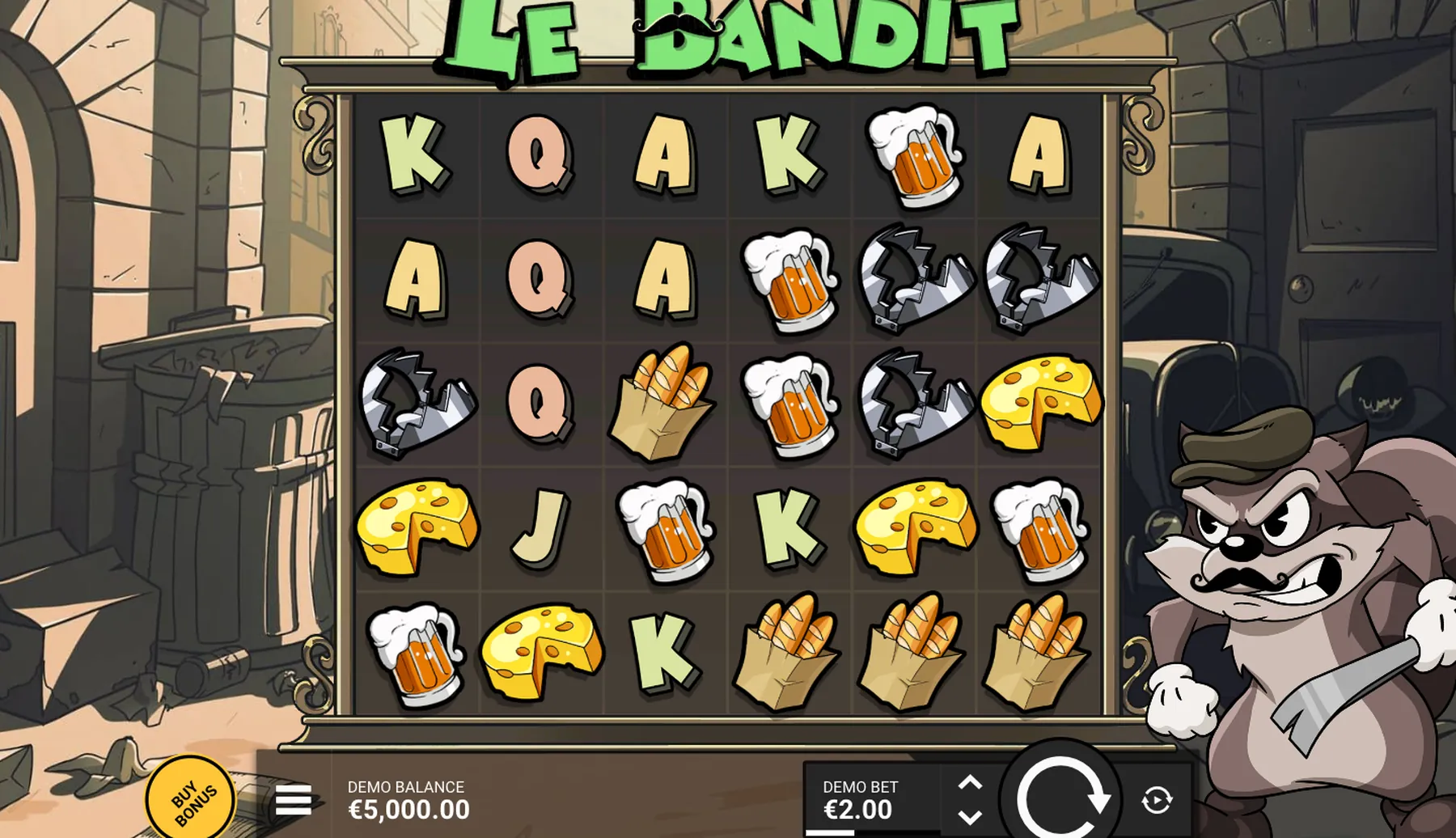
Table of contents
- Le Slots Strengths and Weaknesses
- What Each of the Four Paid Cards Costs and Returns, Recorded at a €2.00 Demo Bet
- What €2.00 Buys You in the Demo
- Two Buy-Ins, Two Paid Modes, Four Returns
- The 96.34% Figure Is a Version, Not a Constant
- Golden Squares: How the Round Actually Pays
- What the Paytable Prints at €2.00
- Le Bandit, Le Clubber and Le Hooligan Share One Maths
- The Four Return Versions Hacksaw Publishes for Le Bandit
- Our Le Slots Verdict and Rating
- Key Terms Used on This Page
- What Else Do Readers Ask
Le Slots Strengths and Weaknesses
Pros: What Works Well
- Pro: Hacksaw prints a separate return figure for every buy-in, so you can compare 96.28% against 96.4% before spending anything
- Pro: The bet range runs from €0.10 to €100.00, matching Le Clubber and Le Hooligan, while three titles in the series go to €400.00
- Pro: Coin values are published in full: Silver pays 5x, 10x, 15x or 20x, Gold pays 25x up to 500x
- Pro: The demo needs no account and starts with €5,000 in play money
- Pro: Two one-off bonus buys at 100x and 250x the bet, plus two FeatureSpins modes charged per spin from 3x
Cons: What Holds It Back
- Con: Four return versions exist, and no public list says which one a casino bought
- Con: The €500 All That Glitters buy-in costs 250x the stake while the game caps at 10,000x
- Con: Le Clubber and Le Hooligan run the same numbers, so the series repeats itself
- Con: Bonus-buy prices scale with your stake, which makes the cheap €6 entry look cheaper than it is
- Con: Hacksaw publishes no hit frequency and no odds of reaching the ceiling
What Each of the Four Paid Cards Costs and Returns, Recorded at a €2.00 Demo Bet
| Purchase | What the price buys | Price | Multiple of bet | Volatility label | Published RTP |
|---|---|---|---|---|---|
| BONUSHUNT FEATURESPINS | Per spin (ACTIVATE) | €6.00 | 3x | High | 96.28% |
| RAINBOW FEATURESPINS | Per spin (ACTIVATE) | €100.00 | 50x | Medium | 96.36% |
| LUCK OF THE BANDIT | One bonus entry (BUY) | €200.00 | 100x | Medium | 96.3% |
| ALL THAT GLITTERS IS GOLD | One bonus entry (BUY) | €500.00 | 250x | Medium | 96.4% |
Figures current as of ; the operator's live terms prevail.
What €2.00 Buys You in the Demo
The demo gives you €5,000 in play money and opens at a €2.00 stake, which is the level every price on this page refers to. Wins pay by cluster on a 6x5 grid rather than along lines, so five or more matching symbols anywhere connected will do it. The stake stepper runs from €0.10 to €100.00, and we walked it to both stops to be sure.
The art is Paris by night. Symbols are a backstreet set: beer, cheese, a bread bag, a top hat, a bear trap, and the usual card ranks underneath them. Smokey the raccoon stands at the right of the reels with a crowbar, which tells you most of what you need to know about the tone.
Two Buy-Ins, Two Paid Modes, Four Returns
Only two of the four cards are an entry into the bonus. Luck of the Bandit at €200 and All That Glitters Is Gold at €500 drop you straight into the round, and the client marks them BUY. BonusHunt at €6 and Rainbow at €100 are FeatureSpins modes, charged on every spin you take, and their button reads ACTIVATE instead. All four carry a return figure of their own. That is the part worth reading twice. A buy-in is usually one product at one price, and here the spend splits four ways, with four different odds of being worth it. BonusHunt FeatureSpins costs 3x your stake and returns 96.28%, the lowest of the four. The rules say what each mode guarantees for a set price, and the BonusHunt card goes one step further than that. It prints the odds shift in words on the card itself: each spin is five times more likely to trigger a bonus game. All That Glitters Is Gold costs 250x and returns 96.4%, the highest.
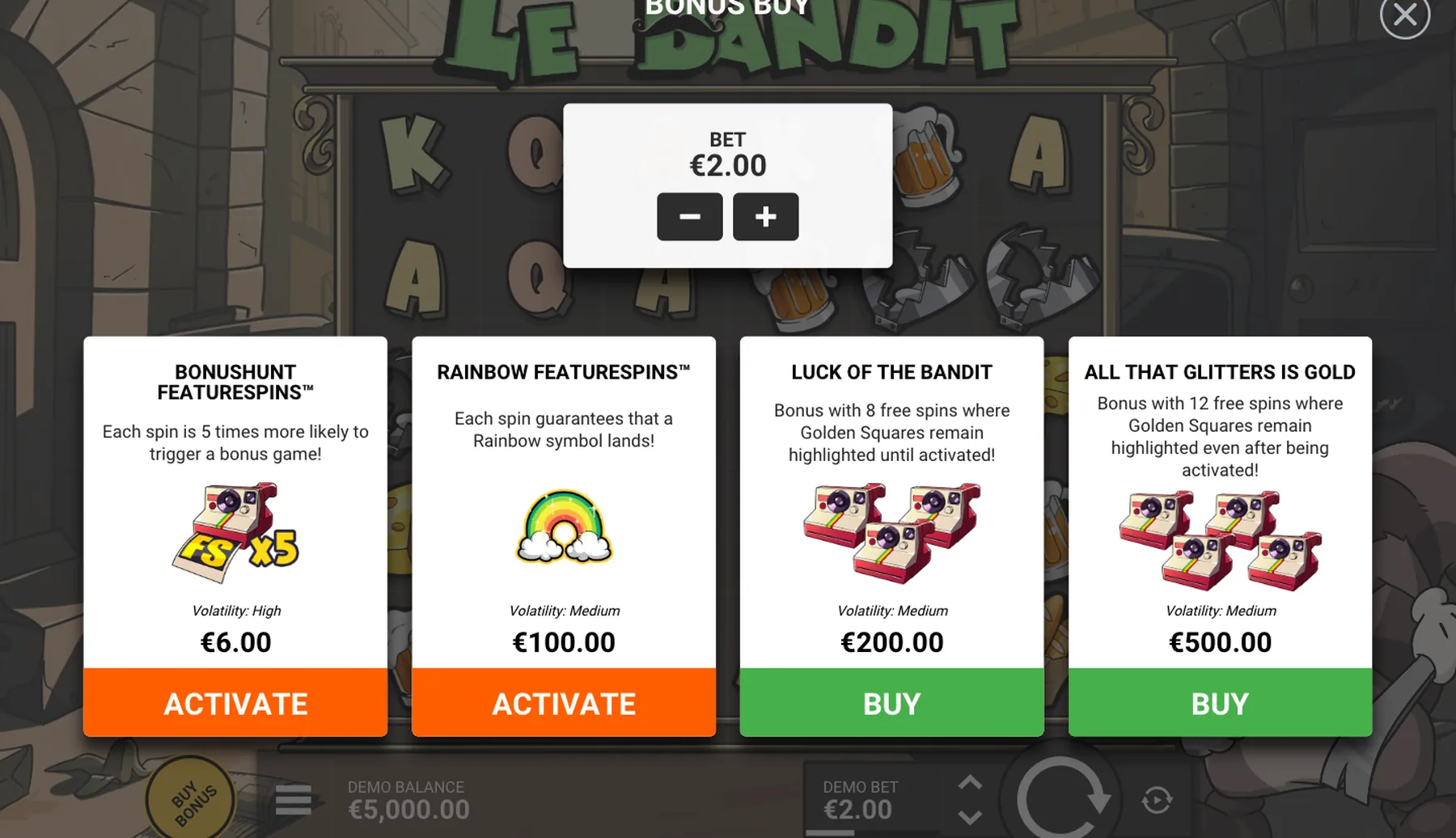
So the cheapest card has the worst published return and the dearest has the best, a spread of 0.12 percentage points across a price range of €6 to €500. The client also labels BonusHunt as High volatility and the other three as Medium, which is the studio's own wording, not ours.
Luck of the Bandit buys 8 free spins; All That Glitters buys 12, and in that round the Golden Squares stay lit even after a Rainbow activates them.
The 96.34% Figure Is a Version, Not a Constant
Hacksaw ships Le Bandit in four return builds: 96.34%, 94.23%, 92.17% and 88.36%. The studio prints all four in the GAME DATA block on its own game page, and its RGS reports 96.34% as the default. Your casino buys one of them. Nothing on the reels or in the paytable says which. The rules screen does print a return figure for the client you are in, but we could only ever check it against the default build: the demo refuses to load the others.
The gap is wide. Between the top build and the bottom one sits 7.98 percentage points, which is a different game wearing the same art. We asked the RGS directly for the three lower builds and it returned an error for each, so the only version anyone can verify from outside is the default.
The studio says it calculated that figure by simulating ten billion rounds. That is a statement about the model, not a promise about your session.
Golden Squares: How the Round Actually Pays
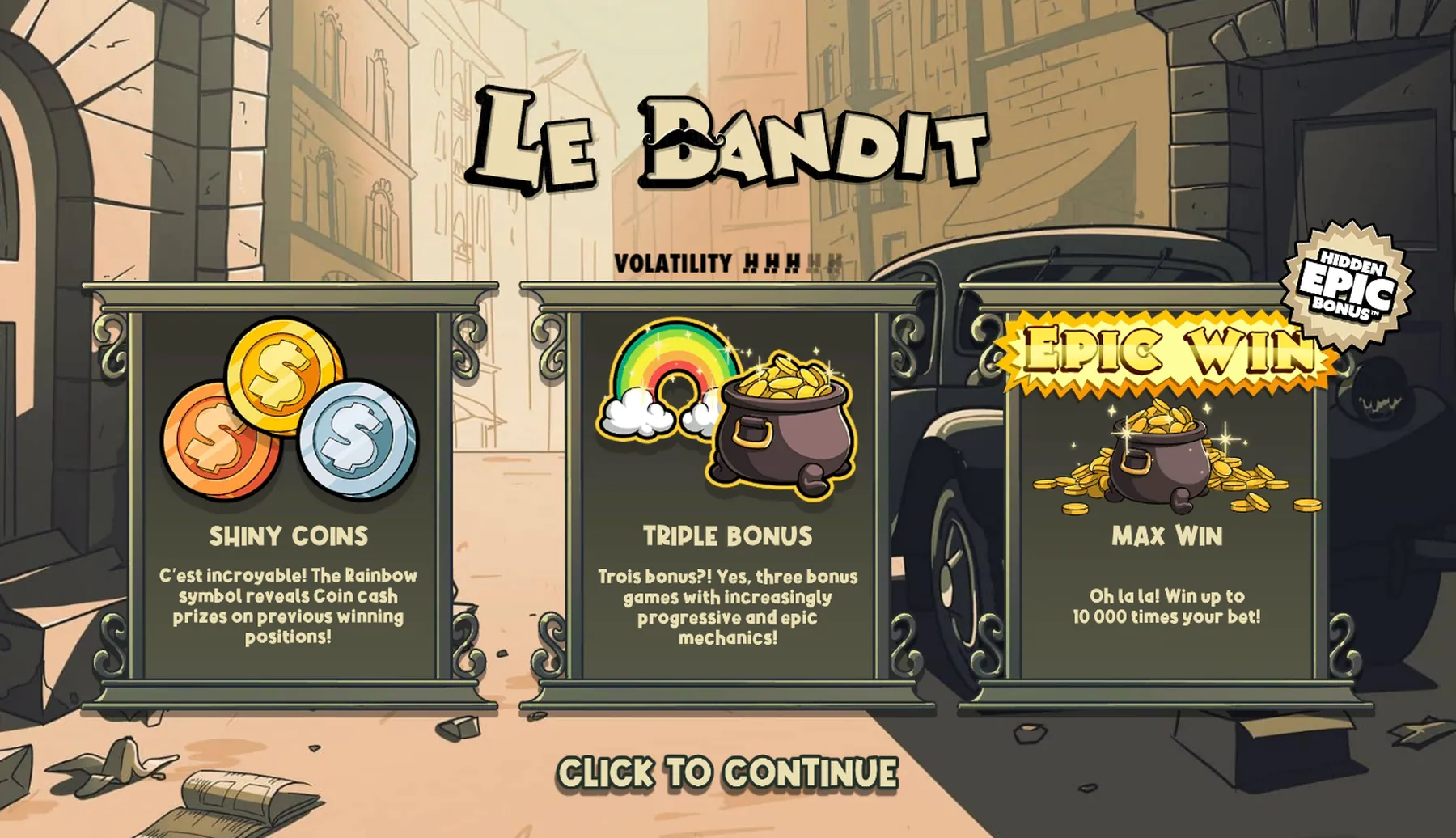
Every position that forms part of a win lights up as a Golden Square. When a Rainbow symbol lands on the same spin, those squares activate and reveal coin values, and that is where the money is.
Silver Coins carry 5x, 10x, 15x or 20x. Gold Coins carry 25x, 50x, 100x, 250x or 500x. Four-Leaf Clovers then multiply the coins on adjacent squares by x2, x3, x4, x5 or x10, and Pots of Gold sweep up the totals around them. Stack a Gold 500x against a x10 Clover and you can see how the ceiling is reached in theory, though the studio publishes no odds for it.
Free spins trigger on three scatter symbols in the base game. Two more scatters during the round add two spins, three add four.
What the Paytable Prints at €2.00
The payout table inside the client is the one place where the numbers can mislead you, because it reads in euros at your selected stake rather than in multipliers. At €2.00, a cluster of 13 or more card symbols pays €30.00, a cluster of 11 to 12 pays €10.00, and a five-symbol cluster pays €0.20.
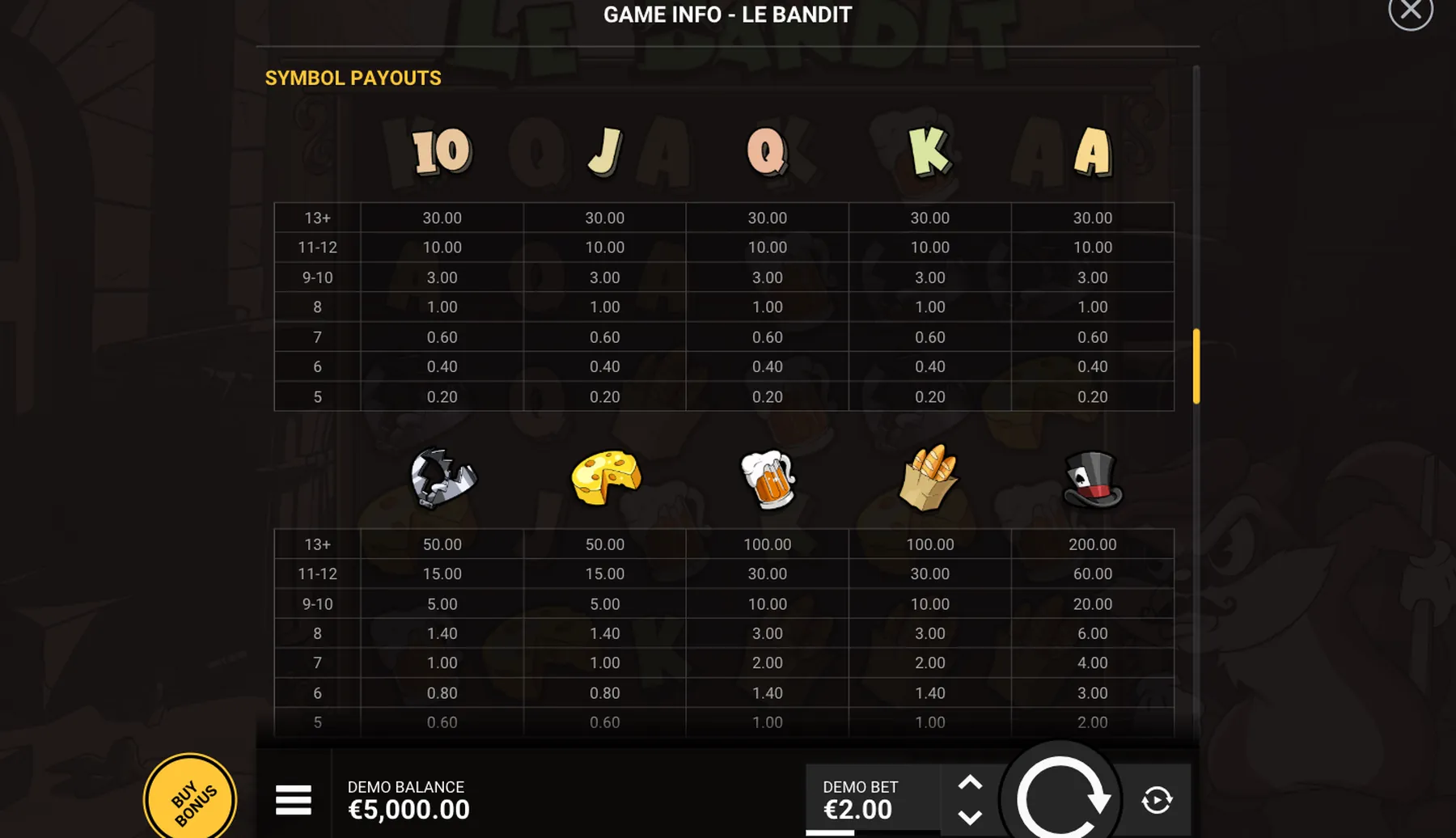
Change the stake and every figure in that table changes with it. The premium symbols sit higher: the trap and cheese pay €50.00 at 13 or more, beer and bread €100.00, the top hat €200.00.
Le Bandit, Le Clubber and Le Hooligan Share One Maths
Three games in this series report identical numbers: a 96.34% default return, a 10,000x cap, a €0.10 to €100.00 range and buy-ins at the same four multiples of stake. Le Clubber launches on and Le Hooligan arrived on , both after Le Bandit's August 2023 release.
Hacksaw has not said these are reskins, and we are not claiming the underlying maths model is literally the same file. What we can say is that every figure on the card matches, down to the per-card returns of 96.28%, 96.36%, 96.3% and 96.4%. One thing does not: Le Bandit publishes a fourth return build at 88.36%, and neither of the other two offers it. If you have played one, the other two will feel familiar for reasons that are visible in the data.
That is also the honest answer to anyone picking between them: the choice is about the art, not the maths.
Readers comparing this against the rest of the catalogue can use our ranking of all seventeen titles, which scores each game on what Hacksaw actually publishes rather than on how it feels to play.
The Four Return Versions Hacksaw Publishes for Le Bandit
| Version | Return | Where we found it |
|---|---|---|
| Default | 96.34% | Studio RGS and the in-game rules screen |
| Second | 94.23% | GAME DATA block on hacksawgaming.com |
| Third | 92.17% | GAME DATA block on hacksawgaming.com |
| Fourth | 88.36% | GAME DATA block on hacksawgaming.com |
Our Le Slots Verdict and Rating
Key Terms Used on This Page
- Cluster pays
- Wins form from five or more matching symbols connected anywhere on the 6x5 grid, not along fixed lines.
- Golden Squares
- Positions that formed part of a win stay lit, and a Rainbow symbol turns them into coin values from 0.2x up to 500x.
- Return version
- One of the four builds Hacksaw ships for this game, from 96.34% down to 88.36%, chosen by the operator.
- FeatureSpins
- A paid spin mode that costs a set multiple of your stake and guarantees certain features, 3x for BonusHunt and 50x for Rainbow.
Deposits and identity checks stay on the operator's own secure site.
Related Reading on This Game
More on this game, from the same section first:
 Games
GamesLe Pharaoh demo
Nine RTP figures, 96.18%–96.35%
 Games
GamesLe Viking demo
Ways wins, 96.32% base, €100 stake top
 Games
GamesLe King demo
96.14% base, 96.36% on the top buy
 Games
GamesLe Zeus demo
19 paylines, 20,000x cap, 96.26% default
 Games
GamesLe Cowboy demo
25,000x cap, highest in the Le series
 Games
GamesLe Santa demo
96.14% base, figures match Le King
 Games
GamesLe Fisherman demo
96.33% default, 15,000x cap, 500x top card price
 Games
GamesLe Bunny demo
Third title sharing 96.14% and 20,000x
What Else Do Readers Ask?
Most questions about Le Bandit come down to two things: which return version you are actually playing, and what the four card prices really buy. Both answers are printed inside the studio's own demo client.
How many free spins does Le Bandit award?
Three scatters trigger the round. Luck of the Bandit buys 8 spins, All That Glitters buys 12, and two extra scatters mid-round add two more.
What is the minimum bet?
Ten cents. We walked the stepper to both stops in the demo and confirmed a €0.10 floor and a €100.00 ceiling on the stake.
What do the Silver and Gold coins pay?
Silver coins carry 5x, 10x, 15x or 20x of the bet. Gold coins carry 25x, 50x, 100x, 250x or 500x, before any Clover multiplier applies.
How often does the game pay its maximum?
Hacksaw does not publish it. Neither the rules screen nor the RGS feed reports hit frequency or odds of reaching 10,000x.
Does the demo run the same return as real money?
No, not necessarily. The demo serves the 96.34% default build, while a licensed operator may instead run the 94.23%, 92.17% or 88.36% version.
When was Le Bandit released?
Catalogues date it to . Hacksaw prints an official date only on its six newest titles, so treat this one as secondary.
How do we test these numbers?
We open the studio's demo client, read the GAME INFO rules screen, record the Bonus Buy panel, then compare both against Hacksaw's RGS data.