

Le Bunny Demo and Review: Third Game, Same Maths
In short — our verdict: 5.9/10 — Le Bunny is the third Hacksaw Gaming release publishing a 96.14% base return, a 20,000x ceiling and four cards at 3x, 60x, 80x and 250x the stake. Our score: 5.9/10. Le King and Le Santa print exactly the same card.
Three games, one set of numbers. Le Bunny joins Le King and Le Santa with a 96.14% base, a 96.36% top purchase and an identical price list, this time wrapped in Easter colours.
5.9/ 10
- Return transparency6.5
- Buy-in design7.5
- Feature depth6.5
- Bet range6.5
- Originality within the series2.5
Table of contents
- Le Bunny Strengths and Weaknesses
- What Each of the Four Le Bunny Cards Returns, at a €2.00 Demo Bet
- Le Bunny Prints a Card We Have Seen Twice
- What a Le Bunny Payout Table Shows
- Practice Mode
- Four Le Bunny Cards with Familiar Prices
- Spring Beats Christmas
- Where Le Bunny Sits in the Series
- The Three Titles That Print One Card, and Where the Names Differ
- Our Le Bunny Verdict and Rating
- Key Terms Used on This Page
- What Else Do Readers Ask
Le Bunny Strengths and Weaknesses
Pros: What Works Well
- Pro: Every one of the four cards states its own theoretical return, so the trade-offs are readable before you spend
- Pro: Swiping the Sweets returns 96.36%, the same premium its siblings offer
- Pro: Spring art works year-round, unlike the Christmas sibling
- Pro: Full coin ladder from 0.2x to 500x with multipliers to x20
- Pro: Every door carries a Medium label, so there are no volatility surprises
Cons: What Holds It Back
- Con: Every published figure matches Le King and Le Santa, so this is the third printing of one card
- Con: A 96.14% base is the joint lowest return in the series
- Con: The BonusHunt mode returns 96.13%, under the base game
- Con: Rainbow Riches, the hidden round, has no published odds
- Con: The stake ceiling is €50.00, half of what Le Bandit allows
What Each of the Four Le Bunny Cards Returns, at a €2.00 Demo Bet
| Purchase | What the price buys | Price | Multiple of bet | Volatility label | Published RTP |
|---|---|---|---|---|---|
| BONUSHUNT FEATURESPINS | Per spin (ACTIVATE) | €6.00 | 3x | Medium | 96.13% |
| RAINBOWCATCHING FEATURESPINS | Per spin (ACTIVATE) | €120.00 | 60x | Medium | 96.31% |
| SPELL OF LUCK | One bonus entry (BUY) | €160.00 | 80x | Medium | 96.31% |
| SWIPING THE SWEETS | One bonus entry (BUY) | €500.00 | 250x | Medium | 96.36% |
Figures as their sources publish them; the operator's live terms prevail.
Le Bunny Prints a Card We Have Seen Twice
A player choosing between these three titles is essentially choosing artwork. Base return, cheapest purchase, dearest purchase, ceiling, stake range and all four prices are the same across Le Bunny, Le King and Le Santa.
Only the names move, and they move everywhere. Here the bought rounds are called Swiping the Sweets and Spell of Luck. Le King calls them Jackpot of Gold and Spin City, while Le Santa uses Sleighing It and Silent Heist. Even the jackpot follows the pattern: Jackpot Eggs on this title against Markers and Boxes on the other two, paying an identical 10x, 100x, 1,000x and 20,000x, with the top prize doubling as the game ceiling. The collectors become Baskets, and the hidden round is Rainbow Riches rather than Viva Le Bandit or Wreck the Halls.
Hacksaw has never officially described these as the same product, and the underlying code isn't something we can inspect. Published figures are, and they match.
Honestly, we went in hoping for a surprise, preferably a mathematical one.
What a Le Bunny Payout Table Shows
Symbol payouts read in euros at your selected stake, not in multipliers, which regularly confuses anyone comparing screenshots taken at different bet levels. Change the stake and every figure in the table moves proportionally with it. The columns follow cluster size, and a winning cluster needs five or more matching symbols connected horizontally or vertically, with a Wild substituting for any paying symbol.
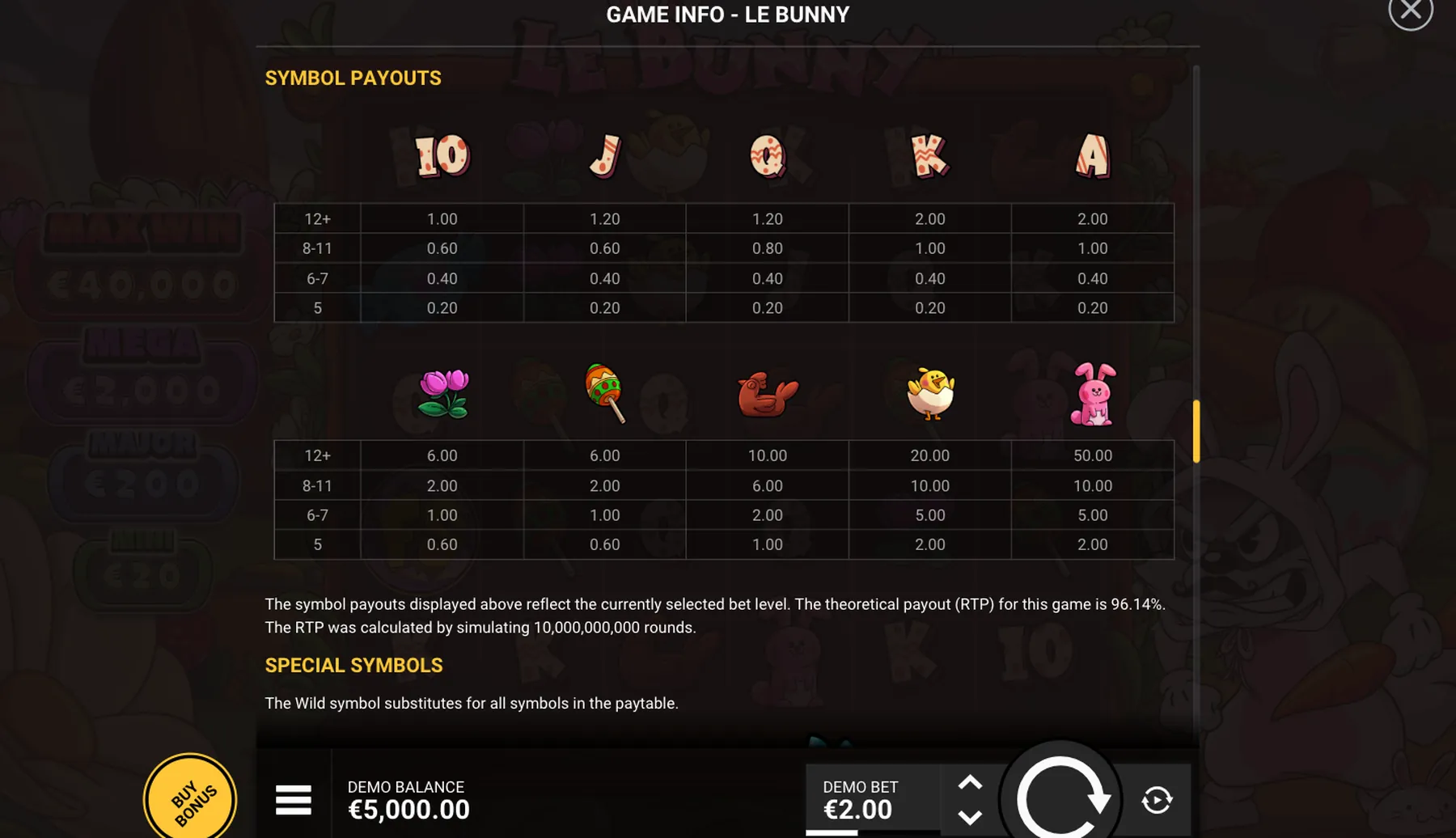
Particularly large amounts sometimes appear abbreviated with letters. The rules explicitly warn that such a displayed value may be rounded down, and they promise that the amount actually credited is never less than what the screen shows. Worth remembering before you photograph a big win.
Behind the paytable sit the coin tiers, described separately in GAME INFO: Bronze from 0.2x to 4x, Silver 5x to 20x, Gold 25x through 500x. Green Clover symbols multiply coins on adjacent squares; Gold Clovers multiply every coin on the grid, at one of x2, x3, x4, x5, x10 or x20. Baskets then collect the coin values and any other Baskets, top to bottom and left to right, while Jackpot Eggs stay outside that collection.
Practice Mode
The studio client loads with a €2.00 bet and a play-money balance. A splash screen comes first, carrying Hacksaw's volatility gauge and the 20,000x headline, and then the 6x5 grid appears with the BUY BONUS button in the bottom left corner and a DEMO BALANCE readout that never touches real funds. Experimenting with the purchase menu costs nothing.
Keyboard shortcuts make the practice session considerably quicker. SHIFT + P jumps straight to the paytable, SHIFT + B opens the purchase menu, SHIFT with the up or down arrow changes the bet, and the spacebar spins. The bar along the bottom keeps the balance, the latest win and the current bet visible throughout, which is genuinely helpful when you're testing what a FeatureSpins mode costs over a longer run of spins.
When you're comparing the three sibling titles, run each client at the identical €2.00 stake. Every price and every paytable figure then lines up identically, and any difference you notice is presentation rather than mathematics.
Four Le Bunny Cards with Familiar Prices
All four publish a return, Rainbowcatching included at 96.31%. That FeatureSpins mode guarantees at least 1 win and 1 Rainbow on each spin, although FS symbols can't land while it runs, so no free spins round can start from it.
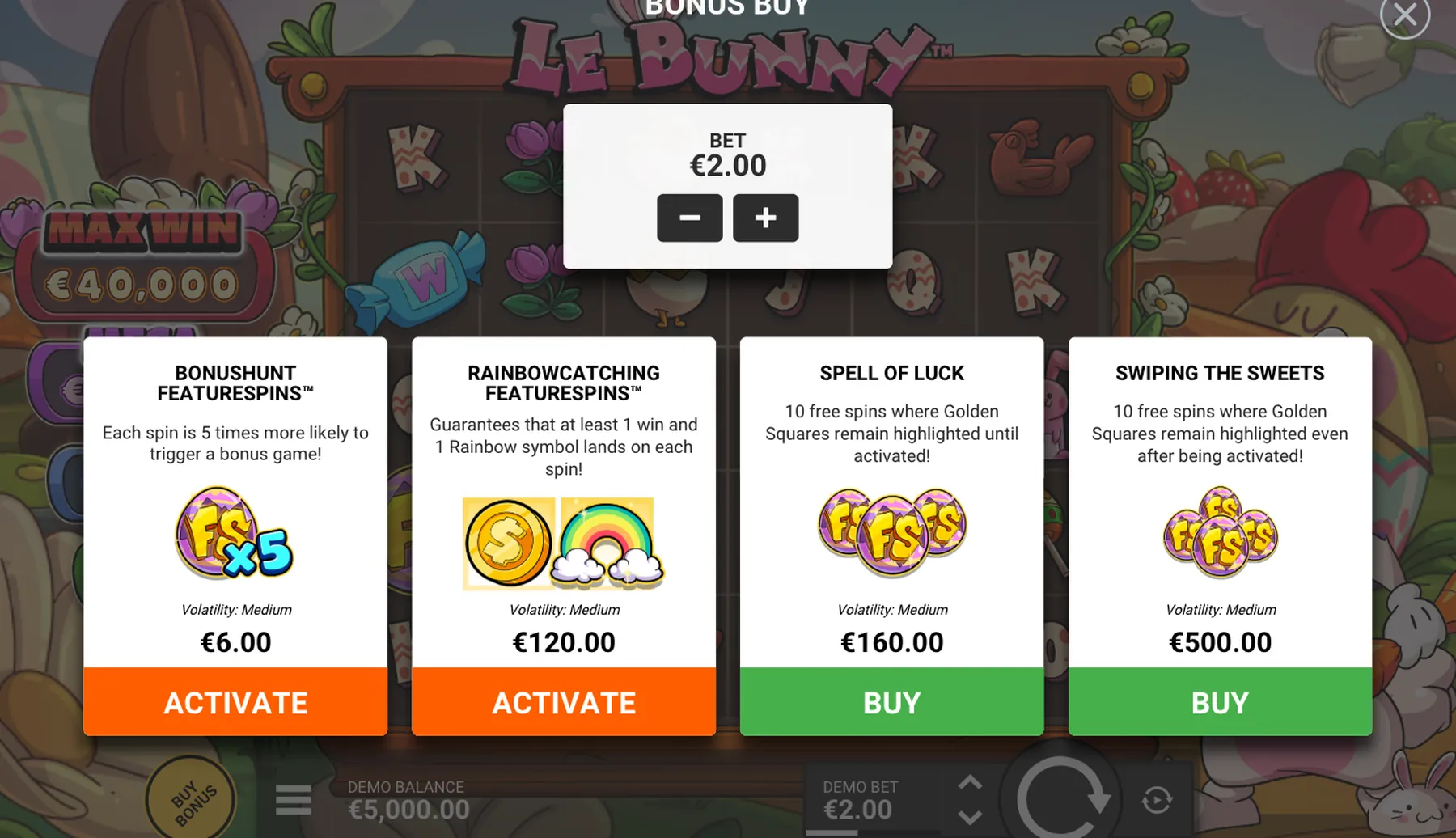
Buying improves your theoretical position here, which is the genuinely useful part of this shared model. Spell of Luck at 80x returns 96.31% and Swiping the Sweets at 250x returns 96.36%, both above the 96.14% that normal play offers. Spell of Luck keeps its Golden Squares progressive until a Rainbow activates them, with a minimum Coin value of 1x. Swiping the Sweets goes further, and its squares stick to the grid until the bonus ends, even after a Rainbow has activated them.
BonusHunt remains the unfortunate outlier at 96.13%. Pay three times your stake and the published figure drops by a hundredth of a point, and you pay it again on the spin after that: BonusHunt is a FeatureSpins mode, so the charge lands on every spin until you turn it off.
Suppose you set the stake at €0.10, the lowest step. The same four cards then cost €0.30, €6.00, €8.00 and €25.00, because every price is a fixed multiple of the bet, independent of anything else. Consider the opposite case too: at the €50.00 maximum stake, the dearest card costs a considerable €12,500.00.
Reaching the Rounds Without Paying
None of the four cards is compulsory, incidentally. When three FS scatters land simultaneously during normal play you get Spell of Luck, four give Swiping the Sweets, and five open Rainbow Riches, each with 10 free spins. Two or three further FS symbols inside a round add two or four additional spins.
Rainbow Riches keeps the Swiping the Sweets mechanics, guarantees one Rainbow per spin, and reveals only Silver or Gold coins. Neither a price nor published odds are attached to it, unless you count the five scatters themselves as the entrance requirement.
If a win reaches 20,000x the bet, the round stops immediately and the remaining free spins disappear. Hacksaw prints no probability for that either, which is disappointing.
Spring Beats Christmas
One advantage over Le Santa is completely calendar-proof. Rabbits and spring colours don't look out of place in August, whereas a sleigh noticeably does. Catalogues date Le Bunny to , and the release date is secondary information rather than a Hacksaw statement, but the theme comfortably suits most of the calendar either way.
That is a thin advantage, and it's the main one on offer. Comfortably the main one, really.
Where Le Bunny Sits in the Series
The 20,000x ceiling places it in the upper half, alongside Le Zeus and its two siblings, below Le Cowboy's 25,000x. Middle of the pack, then.

Disclosure sits at the series median: four published card returns, which eight other titles match exactly. The stake ceiling of €50.00 is half of what Le Bandit allows, so high-stakes players will notice the restriction immediately.
Originality is the weak point, and it costs this title more than its siblings, because it arrived third. Where the structural novelty of a shared maths model might once have been invisible to a player, three identical cards make it unmistakable.
Statistically, the three siblings are interchangeable. Visually, they're anything but, and that's where your decision belongs.
Readers who want the numbers side by side, title against title, will find them in the full Le series catalogue.
The Three Titles That Print One Card, and Where the Names Differ
| Figure | Le Bunny | Le King | Le Santa |
|---|---|---|---|
| Base return | 96.14% | 96.14% | 96.14% |
| Cheapest purchase | 96.13% | 96.13% | 96.13% |
| Dearest purchase | 96.36% | 96.36% | 96.36% |
| Hidden round | Rainbow Riches | Viva Le Bandit | Wreck the Halls |
Our Le Bunny Verdict and Rating
Key Terms Used on This Page
- Shared card
- Our shorthand for a set of published figures that appears identically on more than one title, here 96.14% base and 96.36% top buy.
- Rainbow
- The symbol that activates lit Golden Squares so they can reveal coin values from 0.2x up to 500x.
- Epic Bonus
- A round the rules name but never price; on this game it is Rainbow Riches, reached on 5 FS symbols.
- Clover symbol
- Applies one of x2, x3, x4, x5, x10 or x20 once values are revealed, to adjacent squares when green and to the whole grid when gold.
Deposits and identity checks stay on the operator's own secure site.
Related Reading on This Game
More on this game, from the same section first:
 Games
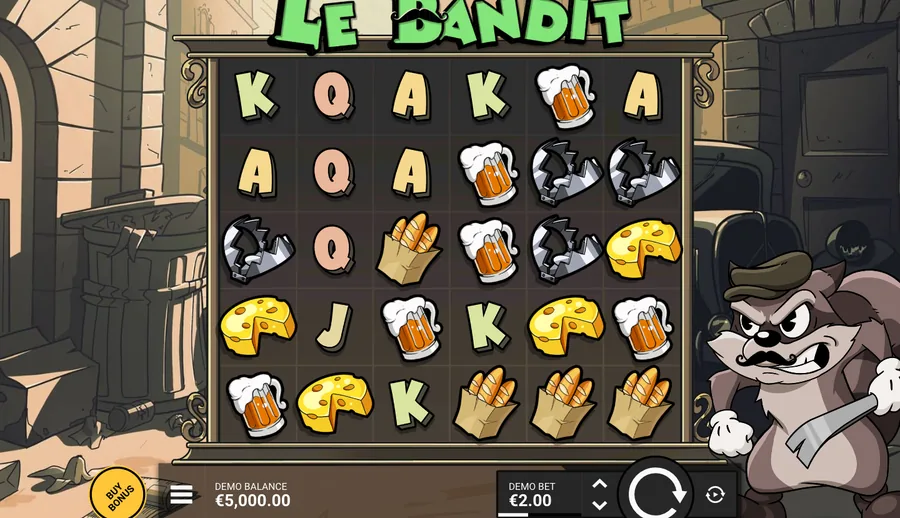
Le Bandit demo
96.34% default, 10,000x cap, €6 entry
 Games
Le Pharaoh demo
Nine RTPs, 96.18%–96.35%, 15,000x cap
 Games
Le Viking demo
15,625 ways, 96.32% base, €100 top stake
 Games
Le King demo
96.14% base, 96.36% on the top buy
 Games
Le Zeus demo
19 fixed lines, 96.26% base, 20,000x
 Games
Le Cowboy demo
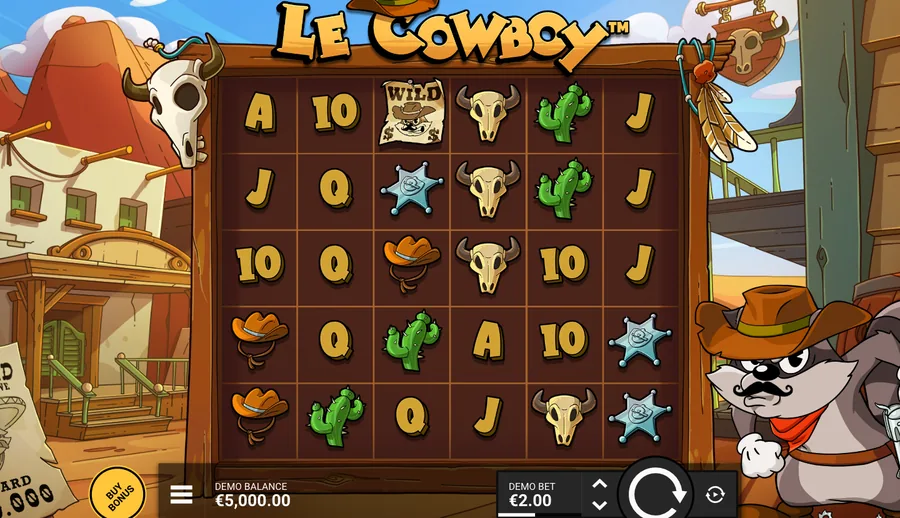
25,000x cap, highest in the Le series
 Games
Le Santa demo
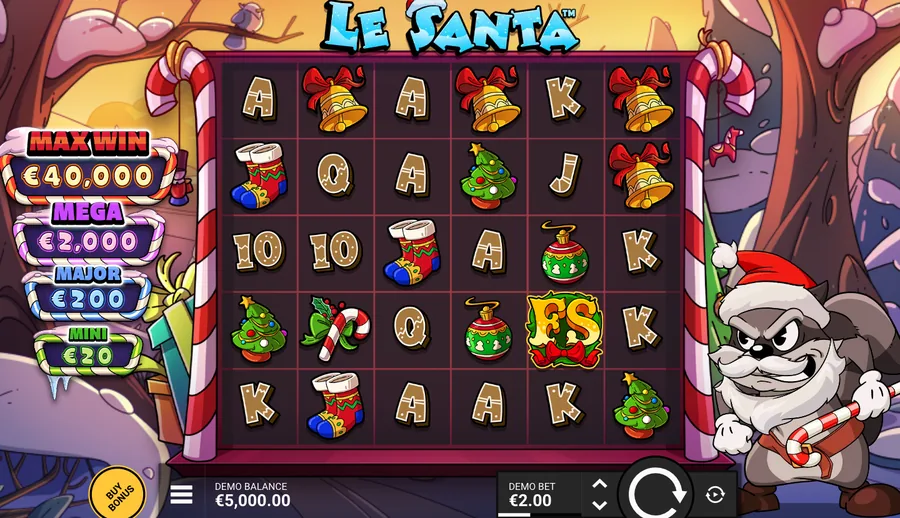
96.14% base, figures match Le King
 Games
Le Fisherman demo
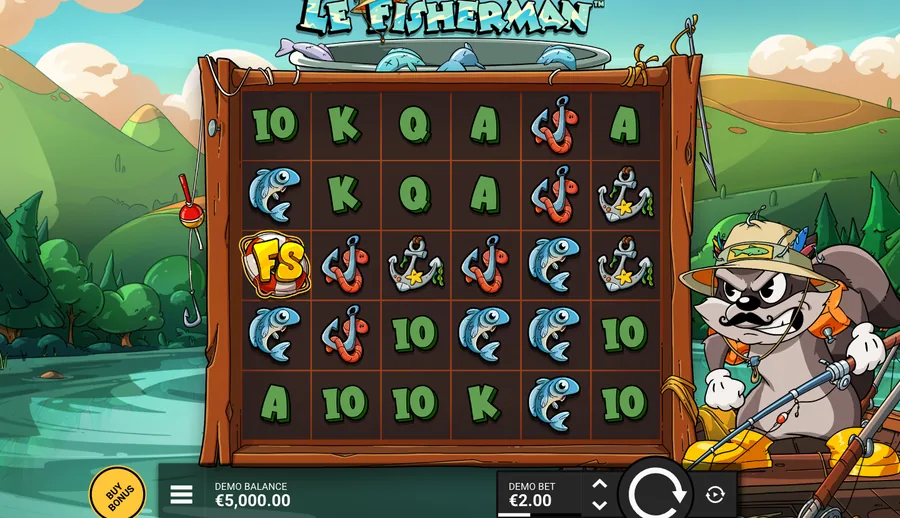
96.33% default, 15,000x cap, 500x top card price
What Else Do Readers Ask?
Le Bunny invites one obvious question: whether it adds anything to Le King and Le Santa. The published figures make that easy to answer, and the remaining questions are practical ones about the client.
Does Le Bunny differ from its siblings?
No, not numerically. Base return, purchase prices, published returns, ceiling and stake range all match Le King and Le Santa exactly, without a single exception.
What is the dearest purchase?
Swiping the Sweets at €500.00 on a €2.00 stake, which is 250 times the bet, and it returns a published 96.36%, the highest figure on the panel.
Which round is hidden?
Rainbow Riches. The rules screen names it as an Epic Bonus but attaches no price and publishes no probability for reaching it.
How do coin values work?
Golden Squares light behind wins, a Rainbow activates them, and the highlighted squares reveal Bronze, Silver or Gold values from 0.2x up to 500x.
Can you reach the bonus without paying?
Yes. Scatter symbols trigger the rounds during ordinary play, and a purchase only skips the waiting or shifts which return percentage applies.
Why does the paytable change?
Payout figures are printed in euros at your current stake rather than as multipliers, so raising the bet raises every number shown automatically.
How do we confirm two games match?
We read both rules screens line by line, then query both game ids in the studio feed and compare every published field individually.