Table of contents
- Hacksaw
- Who Hacksaw Is, Licence by Licence
- The Eight Registers That Carry a Hacksaw Licence
- Layer One: The Return Build a Casino Licenses
- Return Builds Hacksaw Publishes for Each Le Title
- Layer Two: Each Paid Mode Pays Its Own Return
- Base Return Against the Weakest and Strongest Paid Mode Return
- How Big the Catalogue Actually Is
- Three Gaps in What Hacksaw Publishes
- Key Terms Used on This Page
- What Else Do Readers Ask
Hacksaw
Hacksaw is HGMT Ltd, a Maltese supplier of online slot software licensed in eight jurisdictions. The studio sets returns in two layers: a build each casino licenses, and a separate published figure for every paid mode inside a game.
Who Hacksaw Is, Licence by Licence
On paper, Hacksaw is HGMT Ltd: a company registered in Malta as C84111, at 1st Floor Suite 3, Central Business Centre, Mdina Road, Zebbug ZBG9015. A second, separately registered company sits beside it. HGIM Ltd holds the Isle of Man supply licence, so lobbies in different markets can be served by different legal entities under one commercial brand.
That registration number matters more than it usually would. A supplier licence is the one claim about a studio that a reader can verify independently, in a public register. The check takes a couple of minutes, and the number is what makes that verification possible.
If you search the Malta Gaming Authority register for HGMT Ltd, the entry shows MGA/CRP/501/2018 with a validity date of .
The Eight Registers That Carry a Hacksaw Licence
| Regulator | Licence holder | Licence number | Licence valid to |
|---|---|---|---|
| Malta Gaming Authority | HGMT Ltd | MGA/CRP/501/2018 | |
| UK Gambling Commission | HGMT Ltd | 000-054059-R-331396-002 | no expiry published |
| Hellenic Gaming Commission | HGMT Ltd | HGC-000055-MN | |
| ONJN Romania | HGMT Ltd | L2223924Y001379 | no expiry published |
| AGCO Ontario | HGMT Ltd | GRSM1241574 | |
| Spelinspektionen, Sweden | HGMT Ltd | B2B gaming software licensee | |
| Spillemyndigheden, Denmark | HGMT Ltd | 24-432338 | |
| Isle of Man GSC | HGIM Ltd | software supply licensee |
Figures as their sources publish them; the operator's live terms prevail.
We read every row above in the register that issues it, rather than copying it from the studio's promotional pages. Regulators keep those registers public, and they print the holder's name beside each licence number. Two of the eight registers carry no expiry date for Hacksaw, so the column says exactly that.
Layer One: The Return Build a Casino Licenses
The studio distributes many titles in several return configurations and lets the operator choose. Eight of the seventeen Le titles offer a choice of builds; the other nine carry a single figure each.
Return Builds Hacksaw Publishes for Each Le Title
| Title | Return builds | Published build figures | Build spread, best to worst |
|---|---|---|---|
| Le Prechaun | 5 | 97.52% / 96.28% / 94.29% / 92.28% / 86.31% | 11.21 points |
| Le Vampire | 5 | 97% / 96% / 94% / 92% / 86% | 11.00 points |
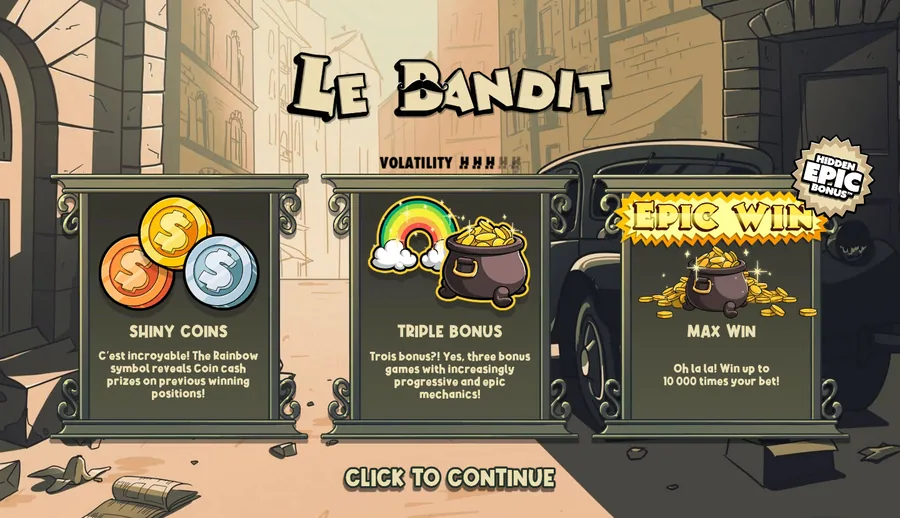
| Le Bandit Hold & Win | 4 | 96.27% / 94.29% / 92.23% / 86.28% | 9.99 points |
| Le Sortudo | 4 | 96.27% / 94.29% / 92.23% / 86.28% | 9.99 points |
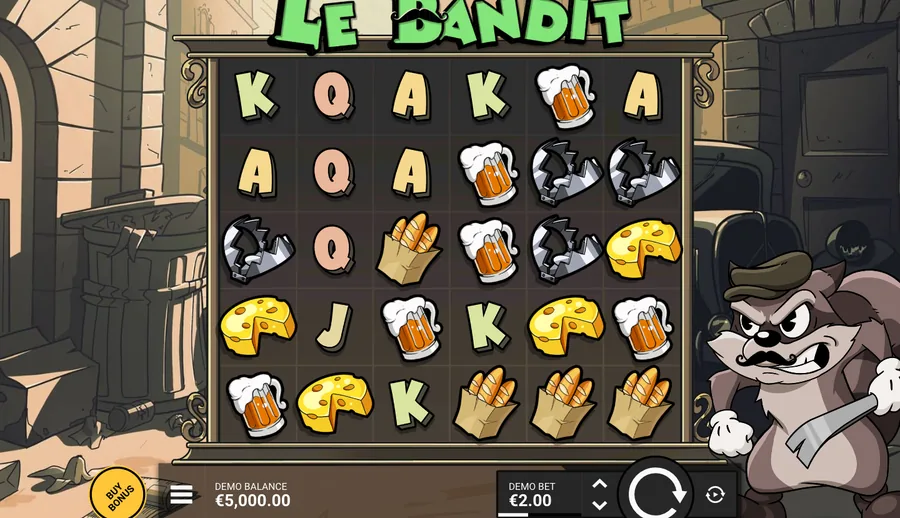
| Le Bandit | 4 | 96.34% / 94.23% / 92.17% / 88.36% | 7.98 points |
| Le Clubber | 3 | 96.34% / 94.23% / 92.17% | 4.17 points |
| Le Hooligan | 3 | 96.34% / 94.23% / 92.17% | 4.17 points |
| Le Football Fan | 3 | 96.41% / 94.29% / 92.30% | 4.11 points |
Le Clubber and Le Hooligan publish identical configuration lists, and they match on the paid-mode figures further down as well.
The Le Vampire row carries the studio's own rounding, not ours. Its data feed reports 96.36% as the default, while its game page lists all five versions in whole percentages.
The last column is the information a player can't see from the lobby.
Suppose a casino runs Le Prechaun on its 86.31% build. Over a sufficiently long run of play, the theoretical return on every €100 staked falls from €97.52 on the best configuration to €86.31, a difference of 11.21 percentage points that the reels themselves never announce. The rules screen does print a return figure for the particular client you are in, and that is the closest thing to a definitive answer. Whether it follows the licensed build is something we can't demonstrate, because the demo serves only the default configuration.
For players, the practical consequence is straightforward. Identical artwork and identical mechanics can hide very different mathematics, depending entirely on a commercial decision made before anyone spins.
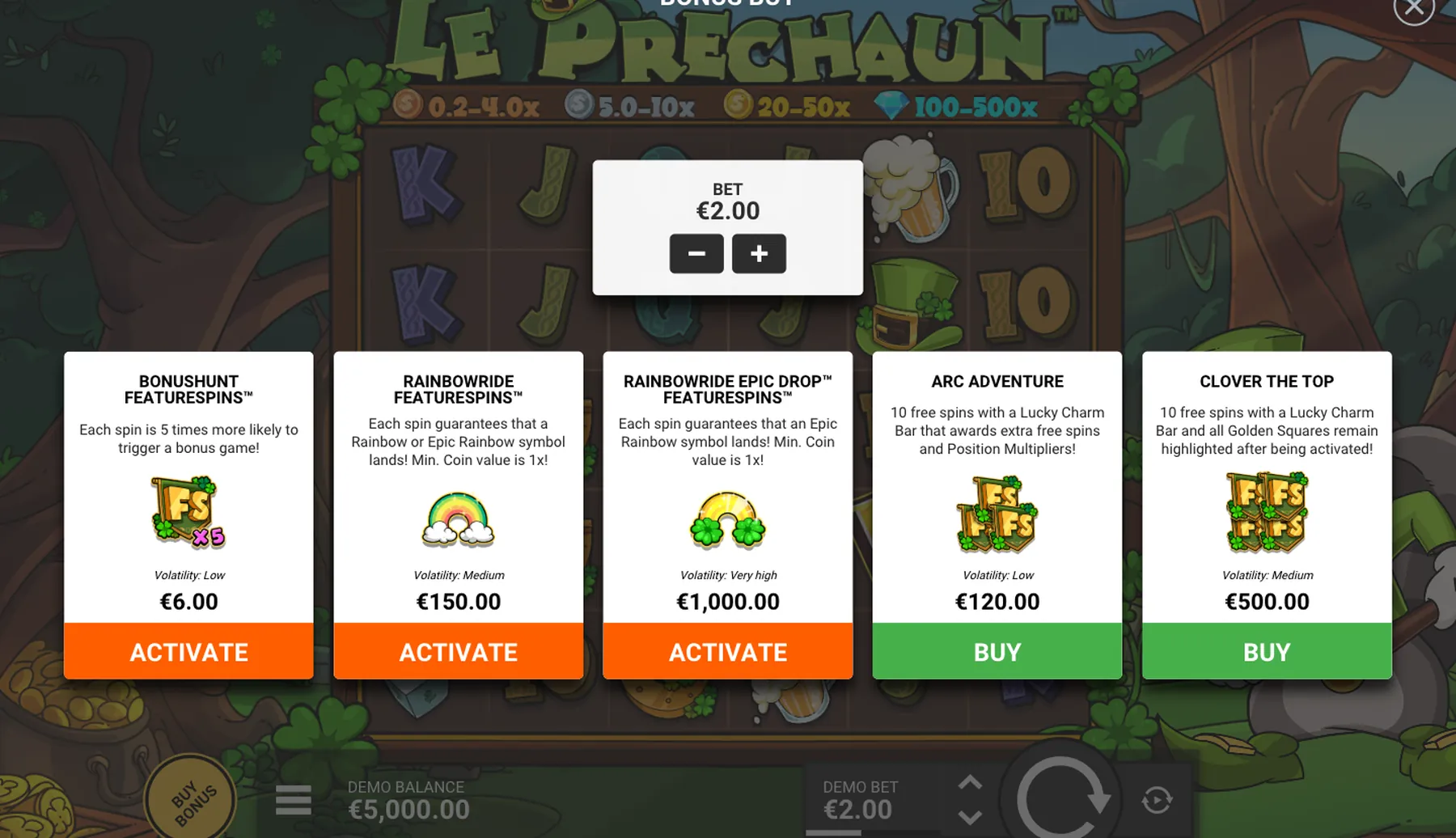
We tested whether the data feed would serve the lower builds on request. Requesting anything other than the default configuration returns an error. A public demo therefore always shows the default, which is sometimes below the best one: 96.28% against 97.52% on Le Prechaun.
Layer Two: Each Paid Mode Pays Its Own Return
Inside a game, every paid mode has a published return of its own, and paying is rarely a shortcut to a better percentage. On fourteen of the seventeen titles at least one paid mode pays back less than the base game.
Base Return Against the Weakest and Strongest Paid Mode Return
| Title | Base return | Weakest paid mode return | Strongest paid mode return |
|---|---|---|---|
| Le Bandit | 96.34% | 96.28% | 96.40% |
| Le Bandit Hold & Win | 96.27% | 96.28% | 96.29% |
| Le Bunny | 96.14% | 96.13% | 96.36% |
| Le Clubber | 96.34% | 96.28% | 96.40% |
| Le Cowboy | 96.28% | 96.10% | 96.33% |
| Le Digger | 96.26% | 96.22% | 96.33% |
| Le Fisherman | 96.33% | 96.14% | 96.33% |
| Le Football Fan | 96.41% | 96.21% | 96.35% |
| Le Hooligan | 96.34% | 96.28% | 96.40% |
| Le King | 96.14% | 96.13% | 96.36% |
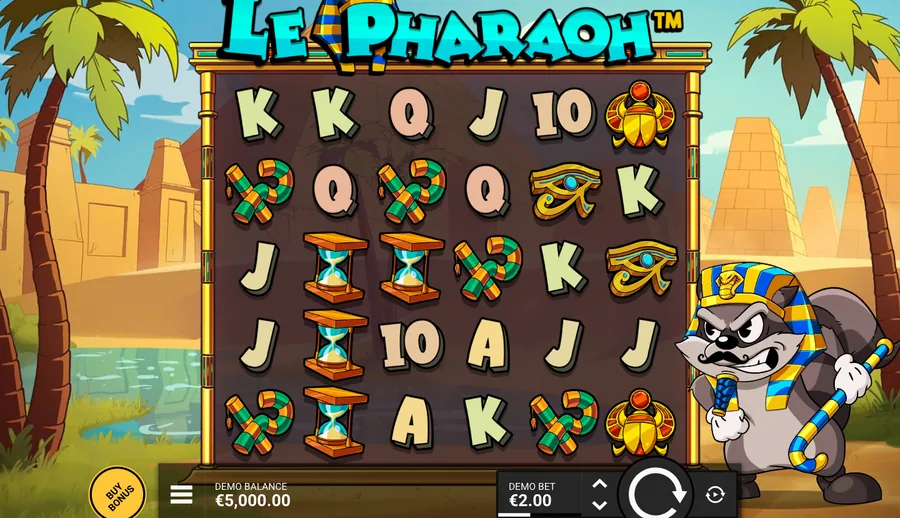
| Le Pharaoh | 96.21% | 96.26% | 96.35% |
| Le Prechaun | 96.28% | 96.25% | 96.31% |
| Le Santa | 96.14% | 96.13% | 96.36% |
| Le Sortudo | 96.27% | 96.28% | 96.29% |
| Le Vampire | 96.36% | 96.12% | 96.36% |
| Le Viking | 96.32% | 96.27% | 96.35% |
| Le Zeus | 96.26% | 96.10% | 96.33% |
Three exceptions break the pattern, and two of them break it for the same reason. Le Sortudo and Le Bandit Hold & Win sell no bonus purchase at all, because they charge a price for every individual spin instead, under a Feature Spins button. Both modes sit a hundredth of a percentage point above the base game.
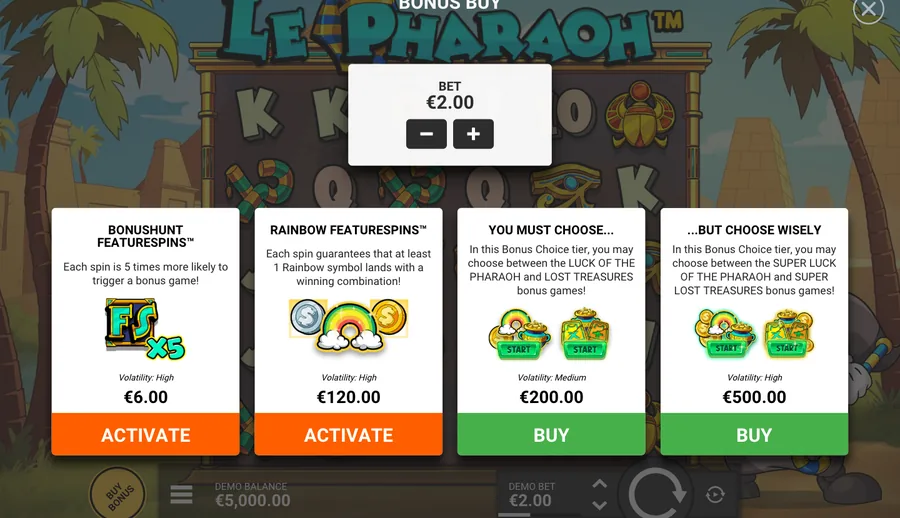
Le Pharaoh is the one title where even the cheapest purchasable option still returns more than the base.
On eight of the fourteen the weakest figure belongs to BonusHunt FeatureSpins, which is also the cheapest thing on the panel. If you activate that mode in Le Zeus, the published percentage falls from 96.26% to 96.1%. When a gamble step inside a round changes the number, the studio prints each branch separately, which is why Le Cowboy and Le Digger go furthest in sheer count, at thirteen figures each. Le Pharaoh goes furthest in alternative routes, with nine figures that depend on how the bonus started and which of four rounds a player picked.
Consider what that means at the panel: on those three titles the choice itself has a published price, and a careful reader can compare the alternatives before paying for any of them.
How Big the Catalogue Actually Is
The studio's own listings contradict each other. We scrolled both listings completely on 5 October. The general games listing ended at 153 unique titles and the slots listing at 141, yet they each returned exactly sixteen names beginning with "Le ".
The seventeenth we found by probing. Le Clubber had a game page and a full data block, but no listing entry, because it had yet to launch. We tried 228 candidate addresses of the same shape, and that was the only hidden hit. Two invented names returned 404, which is how we know the probe was trustworthy.
Honestly, a studio this precise about percentages being vague about its own catalogue size is a little funny. That mismatch is also the reason this site counts seventeen Le titles and explains where the number came from.
Three Gaps in What Hacksaw Publishes
Three categories of information are missing, and a page claiming otherwise is quoting something that doesn't exist.
Hit frequency and the statistical probability of reaching the maximum win appear nowhere in the documentation: the data feed returns zeroes for both, and the rules screen prints neither. Individual titles also carry no public certificate, so a page showing a certificate number for one Le game is referencing a register that holds no such entry.
Release dates are a partial case rather than a completely missing one. The GAME DATA block appears on titles released from June onward, and six of the seventeen carry an official date there. Ten take their date from affiliate catalogues, which this site marks as secondary sources, and one carries no date at all.
Readers who want to check any of this themselves can follow our guide to the studio demo client.